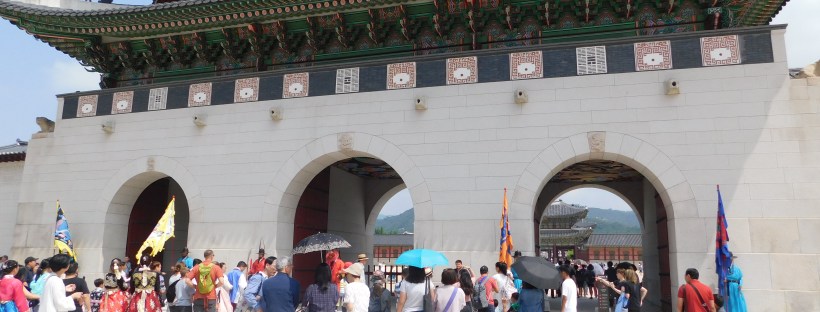
When traveling to South Korea, especially for students of Korean history and/or language, Gyeongbokgung (경복궁) should be at the top of your list to visit. This palace is where King Sejeon (세종대왕) and his scribes developed Hangul (한글), the Korean written alphabet, as well as where he invented various musical and agricultural instruments.
The palace, the center of power during the Jeoson Dynasty in Korea, sits on just over 100 acres in central Seoul and is divided into two sections: the outer court for political functions and the inner court for family and personal functions. However, it was burned to the ground during the Japanese invasion in 1592 and rebuilt in 1867. There were originally about 500 buildings on the site but 90% were destroyed during the 1910-1945 Japanese occupation of the Korean Peninsula. The restoration process began in 1990 and is ongoing.
The palace complex is beautiful but extensive, so I suggest taking advantage of one of the tours which are free, aside from the palace entry fee of roughly 10,000 KRW (about 10 USD). You can walk the complex on your own, but there are certain small details you will miss, such as the golden dragons on the ceiling in one building, or the history behind the queen’s gardens. If you choose to join a tour, you will also learn about each of the main buildings and their purposes as well as two of the national treasures of Korea. Whether you choose to brave the complex on your own or join a tour, you are guaranteed to get your money’s worth from all of the beautiful architecture. You can also watch the changing of the gate guard and the changing of the palace guard at the first gate (for free) if you are there at the right time of day.
Gwanghwamun Plaza (광화문광자) sits just before the gate and directly across from the US Embassy building. There is a large statue of King Sejeon as well as a statue of Admiral Yi Sun-sin, famous for his role in protecting Korea through the use of turtle ships and never loosing a battle (even the one in which he died). Because both men are highly revered, this square has become a popular place not only for domestic and international tourism, but also as a place for citizens to make use of their right to free speech via protests and rallies. While I was there, two peaceful gatherings were going on side-by-side, though both sides disagreed.
Whether you choose to visit the area just to look at (and maybe take a picture or two with) the statues, watch the changing of the guard, or do a tour, I recommend spending some time in the area. It is amazing to walk out of the subway into the hustle and bustle of an active urban center and then look up and see a traditional Korean palace backed by the mountains. I’m absolutely certain that my words do not do justice to the beauty of the new/traditional and natural/urban combination.
 A Drifting Diary